
Discover Hidden Value • Connect Your Assets
Build New Opportunities • Create Lasting Impact
How to Discover the Hidden Value in the Work You Have Already Created
The Melli Ecosystem Method™
helps creators, experts, organizations, and mission-driven leaders identify overlooked assets and transform them into connected opportunities for impact, preservation, growth, and sustainable revenue.
Many people believe they need to create something entirely new before they can grow their audience, expand their influence, or generate additional income. Often, the opposite is true.
Experienced creators, professionals, educators, advocates, musicians, broadcasters, nonprofit leaders, and organizations may already possess years—or even decades—of valuable work.
The problem is that those assets are often scattered across different formats, platforms, storage systems, projects, and relationships.
A valuable television archive may sit unused.
A musician may have unreleased recordings, photographs, lyrics, performances, and stories that have never been organized into a larger body of work.
A nonprofit may have decades of research, reports, interviews, campaigns, educational materials, and institutional knowledge that are difficult to find and rarely reused.
An expert may have delivered hundreds of talks, written articles, advised clients, taught classes, and developed original ideas without ever connecting those assets into a clear system.
In each case, the value already exists.
What is missing is a process for recognizing it, organizing it, connecting it, and determining what it could become.
What Are Hidden Assets?
Hidden assets are valuable materials, knowledge, relationships, experiences, and opportunities that already exist but are not being fully recognized or used.
They can include:
-
Video and audio archives
-
Books, articles, manuscripts, research, and notes
-
Interviews, presentations, workshops, and lectures
-
Photographs, graphics, designs, and historical materials
-
Unreleased creative work
-
Professional knowledge and lived experience
-
Existing audiences and communities
-
Business, nonprofit, educational, and media relationships
-
Brands, websites, platforms, and technologies
-
Intellectual property and original methodologies
-
Stories that have never been fully told
-
Programs or projects that could be updated, repackaged, or expanded
The greatest hidden asset may not be one individual item.
It may be the relationship between several assets that have never been connected.
A collection of interviews may become a book.
That book may become a documentary.
The documentary may produce short-form videos.
The short-form videos may lead audiences to educational resources, speaking engagements, workshops, memberships, licensing opportunities, or a searchable digital archive.
The value increases when the pieces begin working together.
The Problem Is Usually Not a Lack of Ideas
Accomplished people often have more ideas than they can reasonably pursue.
The real challenge is deciding:
-
Which opportunities are strongest
-
Which assets should be preserved
-
Which projects can produce near-term value
-
Which ideas require long-term development
-
Which assets can reinforce one another
-
Which opportunities do not deserve attention yet
-
What sequence will create the best results
Without a clear strategy, valuable work may remain unfinished, disconnected, underused, or forgotten. People may continue creating new material while overlooking the potential of what they have already built. This can lead to unnecessary expense, duplicated effort, lost history, missed revenue, and constant overwhelm.
From Disconnected Assets to a Connected Ecosystem
The Melli Ecosystem Method™ is designed to help individuals and organizations see the larger picture.
The process begins by identifying the intellectual, creative, media, educational, historical, relational, technological, and commercial assets that already exist.
The next step is to examine how those assets might connect.
For example, a long-running television program may contain:
-
Hundreds of interviews
-
Important subject-matter expertise
-
Recognizable guests
-
Historical footage
-
Educational material
-
An existing audience
-
Relationships with organizations and institutions
-
Opportunities for books, documentaries, licensing, teaching, archives, and new digital media
Viewed separately, these may appear to be old programs and stored files.
Viewed as an ecosystem, they may form the foundation of an entirely new publishing, educational, media, and revenue strategy.
The same principle can apply to musicians, authors, nonprofit leaders, educators, consultants, advocates, families, institutions, and businesses.
A Strategic Ecosystem Is More Than Repurposing Content
Repurposing is useful, but an ecosystem strategy goes further.
It does not simply ask:
How can we turn one long video into several short videos?
It asks:
What valuable body of work already exists, what opportunities can it support, and how can each part strengthen the others?
A strategic ecosystem may include:
-
Books and publications
-
Documentaries and video series
-
Short-form digital content
-
Educational programs
-
Workshops and courses
-
Searchable archives
-
Licensing opportunities
-
Speaking engagements
-
Partnerships
-
Membership communities
-
Consulting services
-
Digital platforms
-
Preservation initiatives
-
Sponsorships and earned revenue
-
Legacy and succession planning
Not every asset should become every possible product.
The purpose of strategic ecosystem architecture is to determine which opportunities are appropriate, practical, sustainable, and aligned with the person or organization’s larger mission.
Why an Intellectual Asset Assessment Matters
An intellectual asset assessment creates a structured view of what already exists.
It can help answer questions such as:
-
What have we already created?
-
Which materials have the greatest long-term value?
-
What is being overlooked?
-
What is difficult to find or access?
-
Which ideas could become products or services?
-
What can be repurposed?
-
What should be preserved?
-
What can generate income?
-
What can strengthen audience engagement?
-
What should we develop first?
-
What should we postpone?
-
What should we stop doing?
The result should not be another overwhelming list of possibilities.
It should be a prioritized roadmap.
A useful assessment brings together discovery, inventory, analysis, opportunity identification, strategic sequencing, and implementation planning.
Experience Often Becomes More Valuable Over Time
One of the most overlooked forms of intellectual property is accumulated experience.
A person who has spent decades producing television, teaching, organizing, writing, performing, advising, advocating, building relationships, or solving problems possesses more than a résumé.
That experience may contain:
-
Original methods
-
Repeatable processes
-
Historical knowledge
-
Case studies
-
Lessons learned
-
Professional relationships
-
Credibility
-
Stories
-
Educational value
-
Strategic insights that can help others
The challenge is translating that experience into forms that can be understood, shared, preserved, taught, licensed, or used to create new opportunities.
This is especially important for people approaching a professional transition, organizational change, retirement, succession, or the next chapter of their work.
Their most important future asset may be the knowledge they have already accumulated.
The Role of Technology and Artificial Intelligence
Technology and artificial intelligence can help organize, search, catalog, summarize, and activate large bodies of material.
For example, an archive containing hundreds of interviews may eventually become searchable by subject, guest, quotation, location, date, or theme.
However, technology alone does not create the strategy.
AI may help reveal patterns, but human judgment is still required to determine:
-
What is meaningful
-
What is accurate
-
What should be prioritized
-
What fits the mission
-
What carries ethical, historical, or cultural importance
-
What has real audience or commercial potential
-
What should remain private
-
What should not be pursued
The strongest approach combines technology with experience, context, creativity, and strategic judgment.
The Melli Ecosystem Method™
Frank Melli developed The Melli Ecosystem Method™ from more than four decades of experience connecting strategic planning, media, technology, education, advocacy, publishing, production, public participation, and organizational development.
Throughout his career, he has repeatedly helped people and organizations recognize possibilities within work they had already created.
His approach looks beyond individual projects to identify the larger system:
-
What assets already exist
-
How they are connected
-
What is missing
-
What can be activated
-
What can be preserved
-
What can become sustainable
-
What should happen next
The goal is not simply to create more content.
The goal is to help valuable work achieve more of its potential.
Your Next Opportunity May Already Exist
Before beginning another major project, launching another platform, or spending heavily on new production, it may be worth asking: What have I already created that I am not fully using?
The answer may include recordings, writing, relationships, expertise, stories, archives, research, intellectual property, audience trust, or unfinished ideas.
Those assets may appear disconnected today.
With the right strategy, they may become the foundation of your next:
-
Book
-
Documentary
-
Course
-
Platform
-
Service
-
Partnership
-
Revenue stream
-
Educational program
-
Legacy initiative
You may not need to begin from zero.
You may need to see what you already have—and what it could become.
Begin With an Introductory Conversation
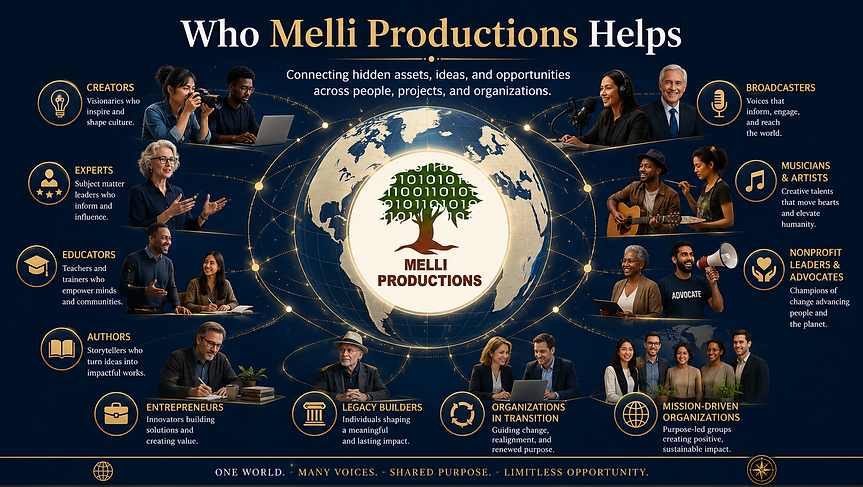
Melli Productions works with experienced creators, experts, media professionals, educators, musicians, nonprofit leaders, advocates, legacy builders, and mission-driven organizations seeking to understand and activate the hidden value within their existing work.
To learn more about The Melli Ecosystem Method™ and the Intellectual Asset Ecosystem Assessment,
visit: MelliProductions.com
Contact Frank Melli
Email: Frank@MelliProductions.com
Phone: 201-282-0785